
Across Europe, university spinouts have become a central pillar of innovation policy, industrial renewal, and long-term economic competitiveness. Yet a striking pattern emerges when examining Dealroom.co's European Spinouts Report – 2025: Switzerland leads the continent by an extraordinary margin in spinout enterprise value per capita. Its deep tech and life sciences spinouts generate more than triple the per-capita value of the next-best performer, and roughly six times that of the Netherlands, a comparable innovation hub with strong universities and research traditions.
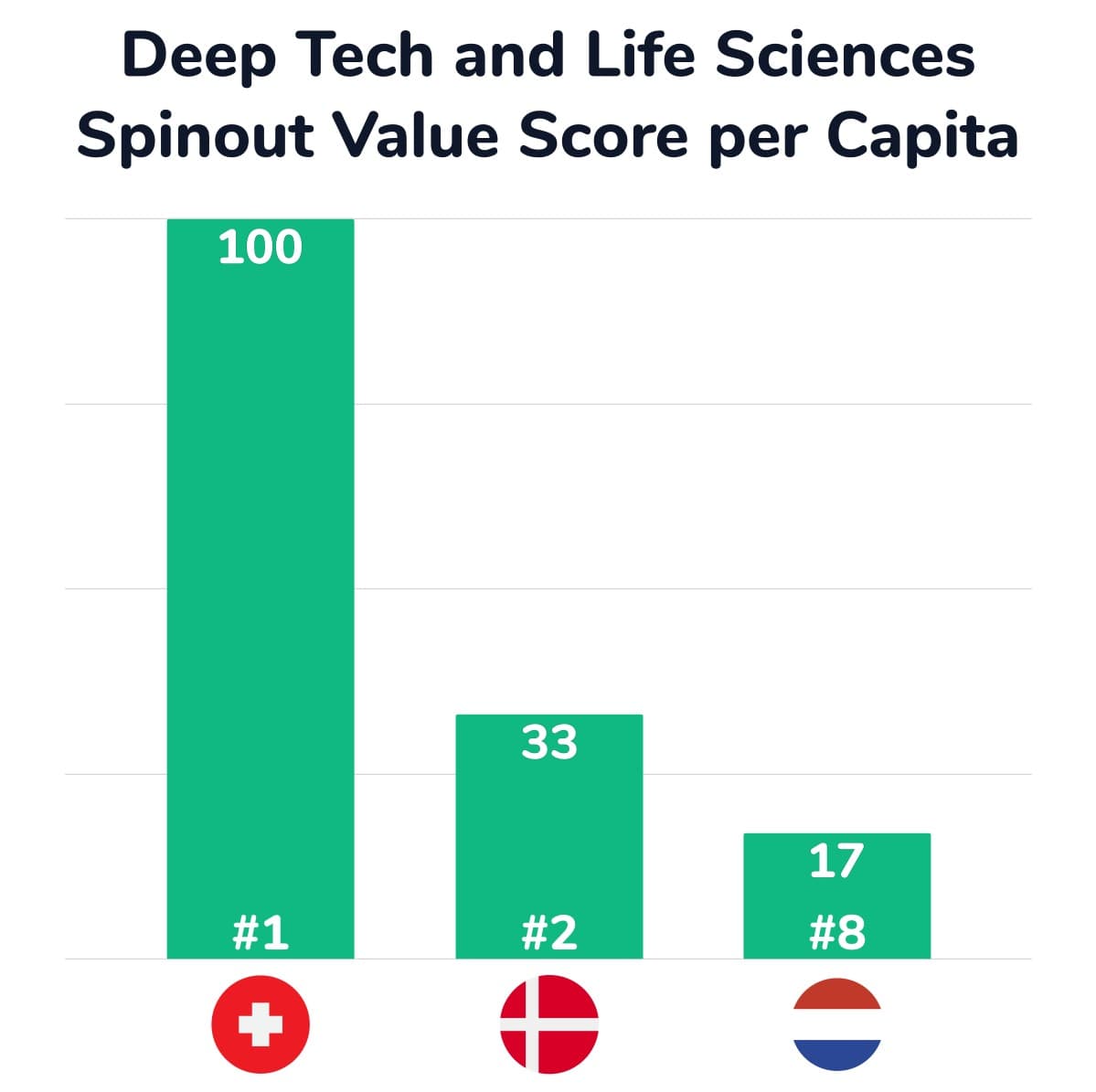
This raises a critical question:
What unique factors enable Switzerland's spinout ecosystem to achieve such remarkable success, and what can other European countries learn from this?
This article explores that question by:
- Identifying key Swiss innovation strengths and structural factors
- Comparing these with the Netherlands, a country similar in many respects but with very different spinout outcomes
- Discussing which levers truly drive the translation of academic research into high-value commercial ventures
- Highlighting limitations and contextual caveats to keep the analysis balanced
Using the Netherlands as a concrete point of reference allows us to spotlight how two small, research-intensive countries with comparable innovation inputs can have vastly different spinout performances. Understanding these differences sheds light on which elements of national innovation systems are most critical for valorizing research and scaling deep-tech ventures.
The Swiss Outlier: More Than Just a Strong Showing
Switzerland stands apart in European innovation per capita, especially when it comes to academic spinouts. While some larger countries outperform Switzerland in absolute terms, Switzerland's spinout ecosystem delivers enterprise value and deep-tech commercialization at a scale unmatched by any other nation when accounting for its size. This isn't just a matter of a few standout successes. Switzerland consistently produces high-value ventures rooted in world-class research, fueled by an abundance of highly skilled talent and a culture that embeds valorization as a strategic priority.
However, many of the underlying strengths driving Swiss innovation, such as strong research institutions, high levels of international collaboration, and a skilled workforce, are shared by other advanced innovation economies. These commonalities raise an important question: why does Switzerland's spinout ecosystem outperform so dramatically? To explore this, we turn to a detailed comparison with the Netherlands, examining key differences that help explain Switzerland's unique success in academic commercialization.
Why the Netherlands Struggles to Match Switzerland in Academic Spinout Value
Although both Switzerland and the Netherlands are recognized innovation leaders with strong research collaboration and digital skills, they diverge sharply when it comes to turning academic research into high-value spinouts. This gap is most visible in spinout value per capita, where Switzerland outperforms the Netherlands by sixfold, as shown in Dealroom.co's European Spinouts Report – 2025.
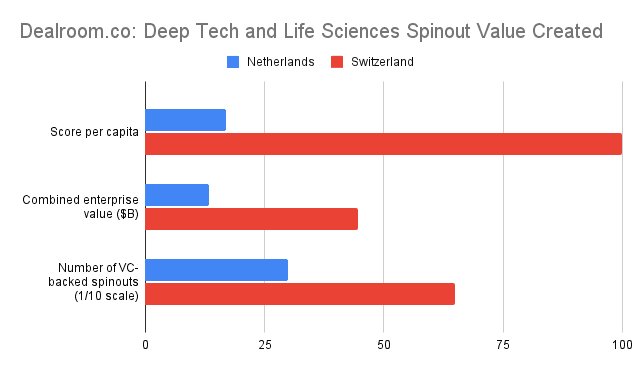
Drawing from the 2025 European Innovation Scoreboards (EIS), the data below provides a detailed comparison of the two countries' innovation ecosystems. While sharing core strengths, their differences shed light on why Switzerland more effectively commercializes academic research.
Similar Strengths
Both countries excel in scientific collaboration, digital literacy, and entrepreneurial engagement. For example, strong public-private co-publication rates demonstrate active academia-industry partnerships, which are essential for bridging research with market impact.
Key Differences in Innovation Metrics
The chart below offers a comparison of select innovation metrics for Switzerland and the Netherlands, each expressed as a percentage relative to the EU average.
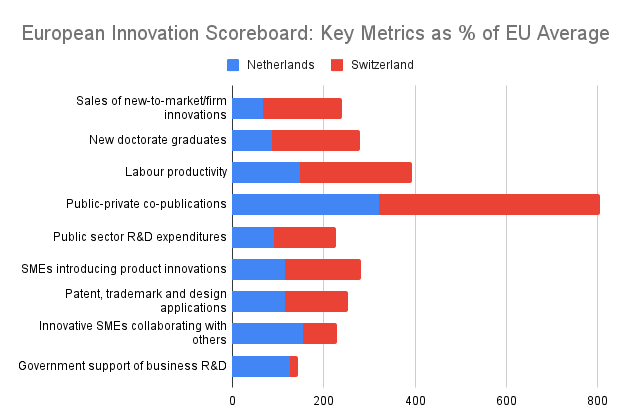
Switzerland reports substantially higher numbers of new doctorate graduates (more than twice the EU average compared to the Netherlands), indicating a deeper pool of advanced research talent. Its public sector R&D investment and public-private co-publications are also significantly higher, suggesting stronger academic-industry collaboration and a more intensive knowledge production base. Swiss SMEs introduce new products at a notably higher rate, and the country shows greater output in intellectual assets and labor productivity.
These metrics collectively underpin the critical capacity to generate, protect, and commercialize novel technologies.
- A larger pipeline of doctoral-level talent feeds deep-tech spinouts.
- Public sector R&D provides foundational science.
- Intensive collaboration accelerates research transfer.
- Active SMEs help bring innovations to market.
Areas Where the Netherlands Excels and Why They May Matter Less for Spinout Value
On the flip side, the Netherlands scores higher on innovative SMEs collaborating with others and government support of business R&D. These point to a more networked SME sector and a policy environment with stronger direct subsidies for corporate R&D activities.
While these strengths support incremental innovation and scale-up within established companies, they may not directly translate into the creation or scaling of high-value academic spinouts. The Dutch innovation ecosystem appears to foster broad-based innovation but may lack some of the structural or cultural levers that transform deep academic research into breakthrough commercial ventures.
Beyond the Numbers: The Swiss Innovation Flywheel
The metrics highlight Switzerland’s strengths in research, talent, and collaboration, but the scale of its spinout success is best understood through the dynamics of its innovation flywheel. Rather than isolated advantages, Switzerland benefits from a reinforcing cycle in which each strength amplifies the next.
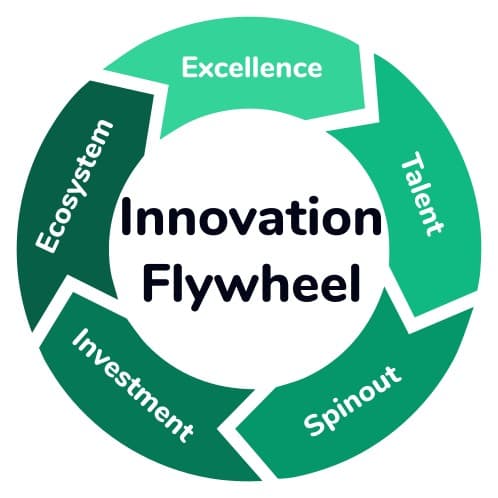
At the heart of this cycle is excellence: concentrated, world-class research that draws global attention. This attracts talent, both domestic and international, creating a steady supply of highly skilled founders and researchers. That talent produces high-potential spinouts, which in turn draw significant investment from Swiss and international sources. These successes strengthen the broader ecosystem, including industry partners, funding instruments, and institutional capabilities. The ecosystem then further elevates the research base itself.
What differentiates Switzerland is not a single policy lever but the compounding of these elements over time. The flywheel turns because each component is aligned and mutually reinforcing, creating a level of momentum that is difficult for other countries to match without similar structural coherence.
Structural Nuances and Limitations
It's important to balance this picture with challenges and nuances in Switzerland's ecosystem:
- Low direct government support for corporate R&D means Switzerland relies less on subsidies for established companies and more on foundational research excellence and private-sector pull.
- Dependence on high-tech imports exposes Switzerland to external supply chain risks.
- Lower exports of medium and high-tech manufactured goods reflect a focus on knowledge-intensive, IP-heavy ventures rather than volume manufacturing.
These factors suggest the Swiss model prioritizes creating high-value, knowledge-based ventures over broad industrial policy measures. It also highlights that success in spinout valorization does not necessarily correlate with traditional metrics like export volumes.
What Can Europe Learn?
Switzerland's extraordinary lead in spinout enterprise value per capita is no accident. It reflects a deliberate, multi-dimensional approach combining world-class research, talent, collaboration, and a national valorization strategy. Though some of these elements exist elsewhere in Europe, their unique integration in Switzerland creates a powerful innovation flywheel that fuels deep-tech commercialization at scale.
For policymakers, universities, and innovation professionals aiming to boost spinout creation and value, these findings offer key takeaways:
- Invest in advanced doctoral education and research capacity: Building a deep talent pipeline enriched with an entrepreneurial mindset is foundational for deep-tech ventures.
- Foster strong, sustained public-private research collaborations: Facilitating seamless academia-industry interaction accelerates commercialization.
- Cultivate a valorization culture: Embed commercialization as a strategic priority across research institutions and funding bodies.
- Recognize the limits of broad subsidies for incremental SME innovation: While valuable, these may not directly increase spinout enterprise value.
- Prepare for structural challenges: Diversify supply chains and balance knowledge-intensive spinouts with broader industrial policies where relevant.
Taken together, these lessons point toward a broader truth: Europe doesn't lack ideas, talent, or ambition. Rather, it needs stronger connective tissue that turns research excellence into commercial momentum. Switzerland demonstrates what happens when those elements align into a reinforcing system rather than a collection of well-intentioned programs.
The next step for Europe is not simply more policy or more funding (though improvements on both fronts matter), but smarter support at the point where commercialization actually happens: the researcher with a promising idea and no clear path forward.
That's why I'm building tools that make this transition easier by supporting researchers to navigate valorization without compromising the academic KPIs their careers depend on. If Europe wants a stronger spinout economy, empowering its scientists is the most scalable place to start.
If you're a researcher, tech transfer professional, or policymaker interested in shaping the next generation of academic commercialization, I'd love to connect. The flywheel won't turn on its own. Let's build the momentum together.