Much of Europe's highest-potential innovation is stalling where researcher expertise ends
Researchers are under pressure to publish, secure funding, and do excellent science. Support teams are under pressure to fit valorization within researchers' existing priorities. The gap in between is where opportunities quietly disappear.
- Research proposals are written without considering IP strategy, limiting commercial opportunities before the project even starts
- Promising projects end with no IP protection or commercialization follow-up
- Patents get filed on inventions that were never commercially positioned, eating your budget without delivering value
First signal to final outcome all in one place
Finding high-potential research before it's too late to act is only half the battle. The support that follows is where the real cost lies, where scaling support requires increased time and resources. A systematic approach changes that: each team member can support more researchers, your institution accumulates the data to make informed decisions, and every commercialization success surfaces the next opportunity that keeps your flywheel turning.
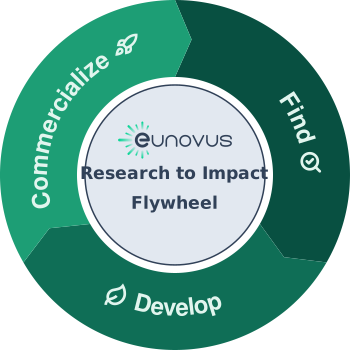
Find. Identify high-potential research before the window closes with automated project assessments that reduce the manual review burden on your team.
Develop. Guide researchers from where they are — grant success, research quality, next publication — toward valorization, without asking them to become entrepreneurs first.
Commercialize. Map the right valorization route and coordinate the legal, IP, and grant support your institution already has, at the moment it's actually needed. Each success is a visible win that brings more researchers to the table earlier.
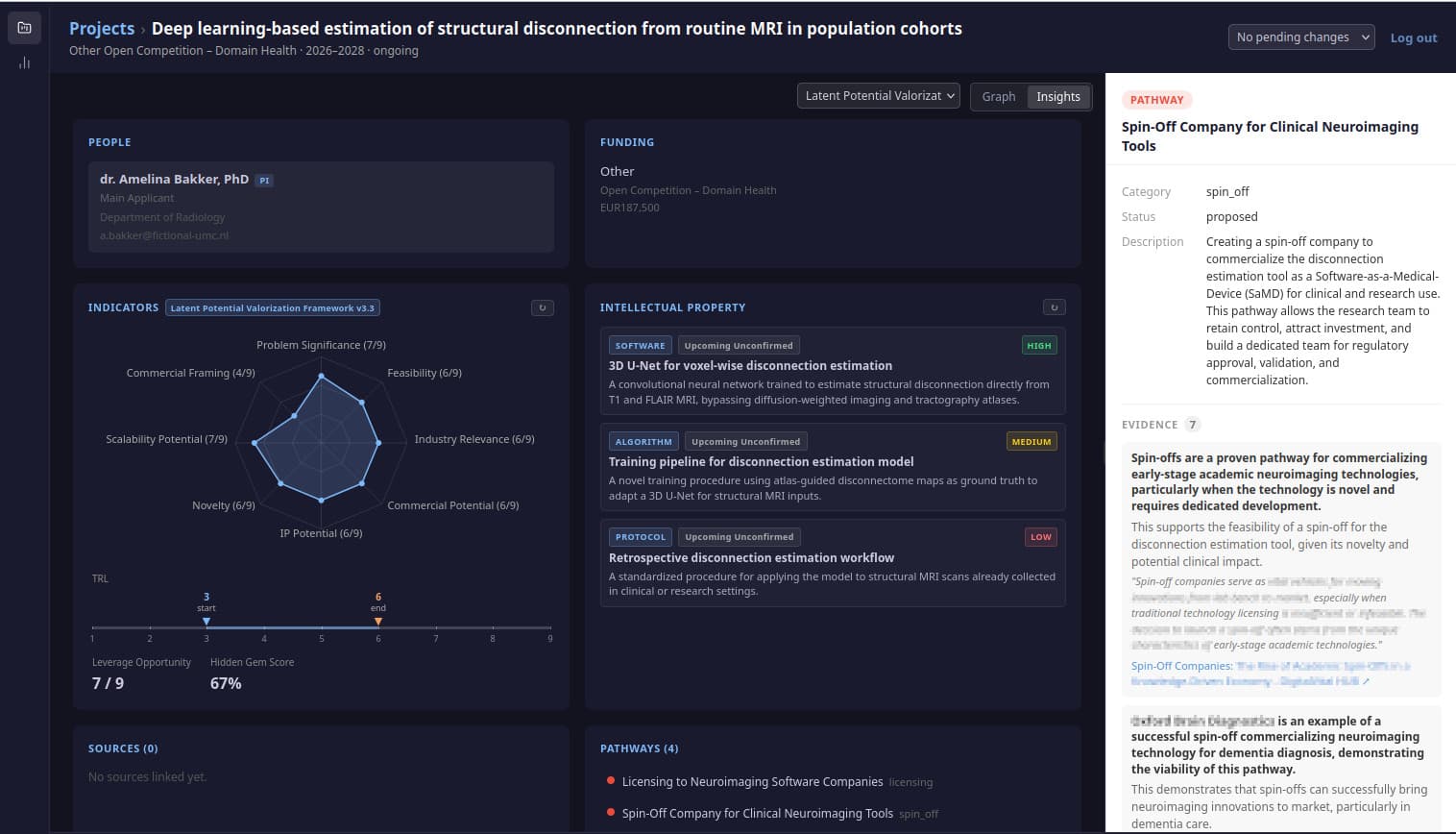
Everything on one screen
Each project opens to a single working view that enables valorization discussions with researchers rooted in evidence: valorization indicators, IP position, funding, and the commercialization pathways worth pursuing.
- Automated valorization scoring. Every project is assessed across multiple configurable dimensions. Our standard set includes problem significance, novelty, IP potential, scalability, and more. This enables repeatable and consistent project scoring and scouting prioritization.
- High-potential intellectual property surfaced early. A first-pass estimate of inventions that could emerge from the project signals which researchers to proactively engage, well ahead of public disclosure.
- Valorization pathways backed by evidence. Potential valorization pathways (spin-off, licensing, etc) are generated based on up-to-date public information, including the reasoning and sources behind it.