
Every day, the headlines remind us of what the world is up against. Climate change, inequality, fragile democracies, dwindling biodiversity, and the pressures of population, technology, and geopolitics all converge to create a sense of urgency that can feel overwhelming. It is like we're caught in a loop of damage control, reacting instead of shaping the future. The margin for error is shrinking.
And yet, I'm a stubborn optimist, and I believe cooperation is our best bet. The window for action is still open
When people align around a shared purpose, creativity multiplies. What feels impossible alone becomes manageable together.
It won't be easy, and it won't happen overnight, but with the right mindset and collective effort, the challenges ahead become opportunities for meaningful impact. This impact is strengthened by creating real value for people and communities. Whether you measure success in social good, innovation, or financial sustainability, these goals can (and must) go hand in hand.
A couple of weeks ago, I saw a small but telling example of that connection. I posted a lighthearted LinkedIn note about voting in the Netherlands. To my surprise, it resonated widely.
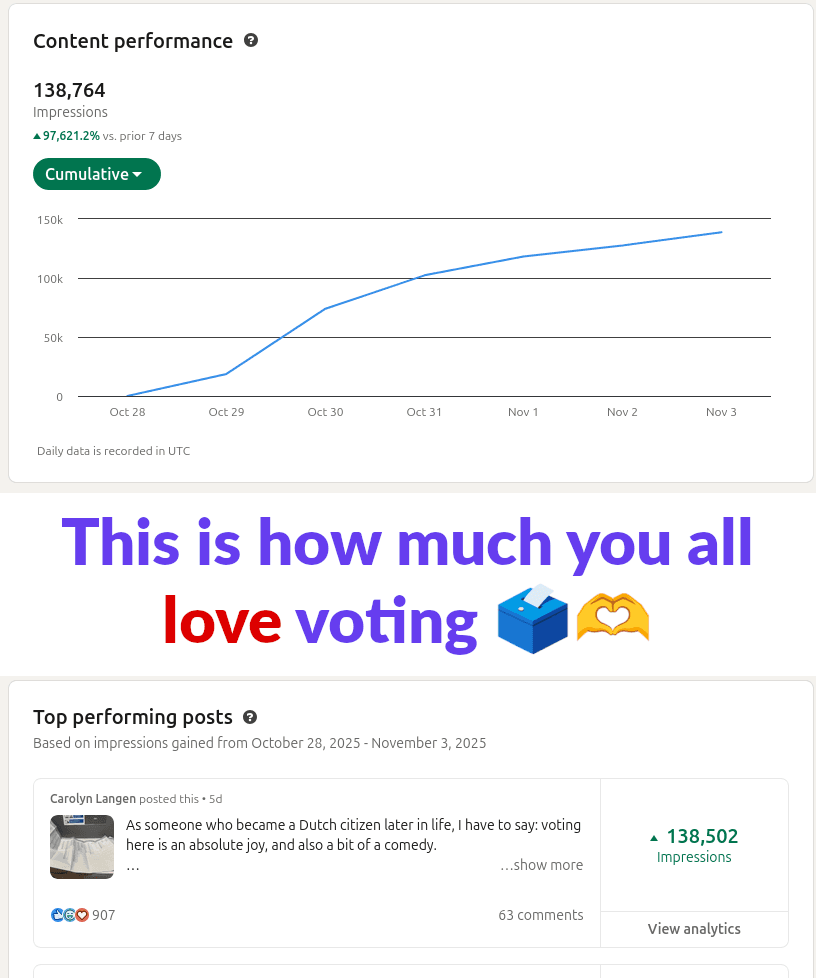
As the comments came in, it wasn't the numbers that struck me but the sentiment: People care about democracy at least enough to pay attention. That collective response reminded me that my optimism isn't unfounded.
Finding What You Truly Care About
In a world this complex, it's easy to lose track of what actually matters to us. We chase deadlines, navigate systems, and adapt to constant change. But somewhere beneath the noise are the things that spark curiosity or ignite conviction. They are issues, ideas, or injustices that make us pause and think, someone should do something about that.
That someone can be you. Taking the time to understand what genuinely drives you is one of the most important forms of action. It doesn't have to start with a grand plan or a career shift. It can start quietly: reading, listening, asking questions, or experimenting in small, deliberate ways. Progress is made with steady, thoughtful steps in the direction that feels right, continuously readjusting as you find your way.
Once you've found that sense of purpose, the next challenge is turning conviction into approaches that last. That's where structure and evidence come in.
Building Change that Lasts
A few years ago, when I was struggling with my desire to be more impactful, I came across Ann Mei Chang's book Lean Impact. It is based on the principles of lean startup, which I was already exploring. The book offers a powerful reminder that doing good effectively requires the same rigor we apply in science or business. It challenges us to combine compassion with evidence and agility. It also emphasizes starting with deep empathy for the people you aim to serve, testing assumptions directly with them, and rethinking the systems, like funding and incentives, that shape how innovation takes root.
It proposes three principles worth internalizing:
- Start small and learn fast: Perfect conditions don't exist, so don't wait for fully developed solutions. Test, learn, and iterate based on what works.
- Measure outcomes, not activity: Doing more isn't always better. What matters is whether your actions lead to meaningful results.
- Think big but grow smart: Sustainable change depends on scalability, which means solutions that expand without losing integrity or inclusivity.
These principles reflect the kind of mindset we need across every sector. Solving global problems will demand experimentation, humility, and collaboration.
My Bet is on Science
I've been part of the research and innovation world since my teen years. The scientific process is in my blood. Science gives us the tools to understand complexity and the methods to navigate it.
One of the places the scientific process takes place is academia. Academia is not perfect and in many ways needs to change. It can be slow, rigid, and constrained by incentives that don't always reward collaboration or real-world impact. But beneath those imperfections lies a foundation of knowledge, rigor, and creativity that the world desperately needs.
Many of today's biggest challenges, from climate adaptation to public health to sustainable technology, hinge on discoveries that have yet to leave the lab. Those discoveries must make it out into the world and scale. That will not happen through isolated efforts. Cooperation is a necessity.
One way to achieve this cooperation is an ecosystem approach. The innovation ecosystem is where researchers, entrepreneurs, policymakers, and citizens meet. When it is healthy, breakthroughs become positive change.
I've seen encouraging signs of this: small groups and organizations quietly forming alliances, sharing data, co-developing solutions. The challenge is that these efforts often remain fragmented. To make a real dent, these pockets of progress need to connect, align, and amplify one another. No single institution or individual can solve global problems alone. But together, we can accelerate the path from discovery to impact.
What You Can Do
If you share this belief in science and its potential to drive positive change, join me. Support open research, fund innovation responsibly, build bridges between knowledge and practice.
If something else drives you, pursue it. The world doesn't just need scientists; it needs artists, educators, community builders, policymakers, technologists, and storytellers.
Either way, living with purpose will keep you anchored when the world feels uncertain. It transforms anxiety into agency and helps you see that small contributions are not insignificant. They compound, connect, and inspire others. In the end, that's what cooperation really is: people choosing, again and again, to care, and to act on that care together.